DFW Multifamily: The Supply Surge and What’s Next
A Data-Driven Analysis of Market Fundamentals and Recovery Timeline
February 2026 | Starcore Capital
Executive Summary
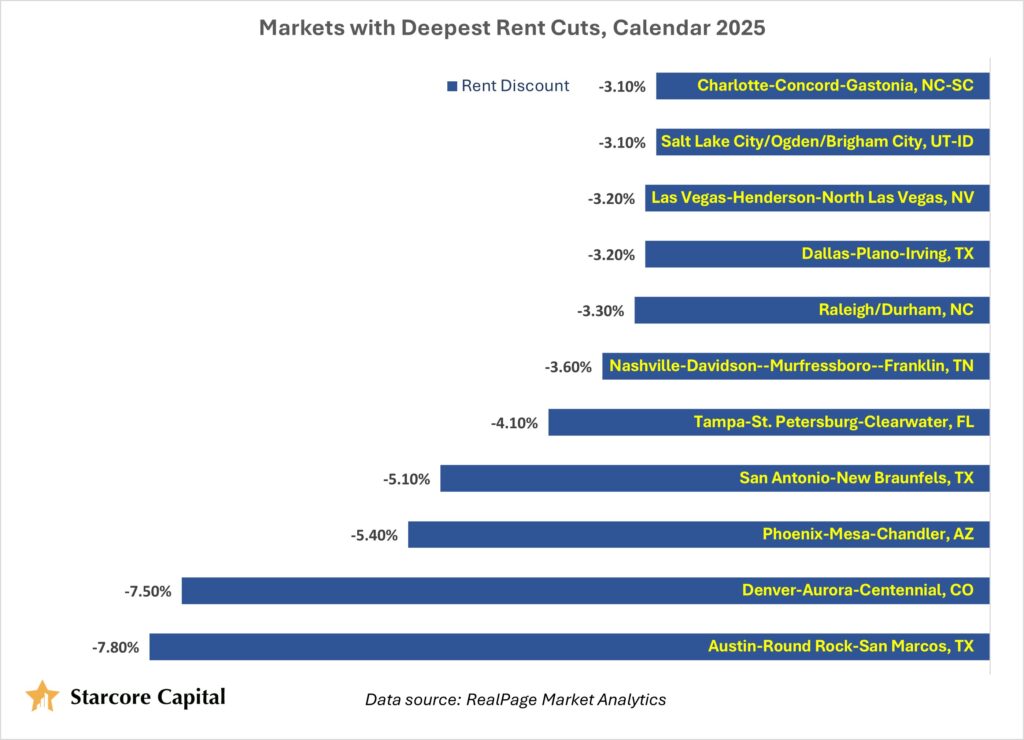
The Dallas-Fort Worth multifamily market has experienced a dramatic transformation, evolving from one of the nation’s tightest markets (95% occupancy in 2022) to facing significant supply headwinds (90.3% in Q1 2025). Our analysis of data from CBRE, MMG Real Estate, ALN Apartment Data, and the Dallas Fed reveals the market is now at an inflection point, with recovery projected for late 2026.
| Key Findings
• DFW remains #2 nationally for absorption (18,700 units) and investment volume ($9.26B) • Supply exceeded demand by 24% in 2025 vs. 5% nationally—a 5x worse imbalance • Construction pipeline declined 55% from 65,000 units (2023) to 29,400 (Q4 2025) • Class C occupancy (91.8%) significantly outperformed Class A (88.1%) by 3.7 points • Investment growth lagged at +4.1% vs. +35% in New York, signaling capital selectivity |
The Market Cycle: From Peak to Recovery
Phase 1: Expansion (2021-2022). Occupancy peaked at 95% in Q3 2022 as demand exceeded supply by 12,000-13,000 units annually. This tight market triggered aggressive development activity, pushing the construction pipeline to a historic 65,000 units by mid-2023.
Phase 2: Peak Supply (2023-2024). Record deliveries of 36,209 units (2023) and 38,640 units (2024) created a 20,849-unit oversupply over two years. Despite absorbing 18,700 units in 2025—second-highest nationally—occupancy fell to 89.9%. DFW’s 24% supply-demand imbalance was five times worse than the 5% national average.
Phase 3: Correction (2025). Deliveries moderated to 23,200 units (-40% from peak) as the pipeline collapsed 55% to 29,400 units. Q4 2025 saw negative absorption (-1,300 units) for the first time since Q4 2022, while investment volume declined -18% year-over-year despite national growth of +7.1%.
Phase 4: Recovery (2026+). With the pipeline projected to fall to 15,000 units by year-end 2026 (-78% from peak) and deliveries normalizing around 22,000 units annually, we expect supply-demand equilibrium by late 2026, setting the stage for occupancy recovery toward the 92-94% historical range by 2027-2028.
Critical Insight: Class-Level Performance Divergence
The most important finding from our analysis is the dramatic performance gap across asset classes, creating distinct investment opportunities:
| Class | Current | Peak | Decline |
| Class C | 91.8% | 97.0% | -5.2pp |
| Class B | 90.9% | 97.0% | -6.1pp |
| Class A | 88.1% | ~96% | -7.9pp |
Why Class C Outperformed: Nearly all new construction was Class A luxury, creating minimal direct competition for workforce housing. Class C properties benefited from affordability (rents 30-40% below Class A), trading-down demand as renters sought value, and established locations with stable tenant bases. The 3.7-point occupancy advantage over Class A represents significant downside protection.
Investment Climate: Capital Rotation Underway
While DFW maintained its #2 ranking with $9.26 billion in 2025 investment volume, growth dramatically lagged peer markets. DFW’s +4.1% increase compared poorly to New York (+35.0%), Seattle (+42.5%), Chicago (+41.1%), and Atlanta (+21.0%). Most telling: Q4 2025 investment fell -18% year-over-year while the national market grew +7.1%.
This capital rotation signals sophisticated investors are pricing in DFW’s supply-demand imbalance and seeking markets with better near-term fundamentals. However, this creates opportunity for investors with 3-5 year horizons who can acquire quality assets at today’s pricing while underwriting conservatively through the adjustment period.
Recovery Timeline and Investment Strategy
H1 2026: Continued adjustment with occupancy in the 89-91% range as remaining supply is absorbed. Concessions elevated but moderating.
H2 2026: Market inflection as deliveries fall to ~11,000 units per half. Occupancy stabilizes at 90-92%, rent growth turns positive (1-2%), supply-demand reaches equilibrium.
2027-2028: Recovery phase with occupancy returning to 92-94% range, rent growth accelerating to 3-5% annually, and cap rate compression as market normalizes.
| Investment Positioning
• Class C: Most attractive risk-reward. Already at 91.8% occupancy, positioned to lead recovery, offers defensive characteristics with upside. • Class B: Value-add opportunity for operators who can improve positioning. Strategic improvements could capture demand from both Class A (trading down) and Class C (trading up). • Class A: Requires strong capitalization and patience. Institutional-quality properties in prime locations should recover but near-term cash flow remains pressured. |
Conclusion
The DFW multifamily market faces a temporary but significant supply-driven correction. The 78% pipeline decline—from 65,000 to 15,000 units—creates the foundation for recovery beginning late 2026. The market’s fundamentals remain strong: DFW leads the nation in job creation, population growth, and economic expansion.
For investors, selectivity is key. Class C and well-located Class B properties with strong fundamentals offer the most compelling risk-reward profile. Markets don’t ring a bell at the bottom—by the time recovery is obvious to all participants, the best risk-adjusted returns will have been captured. The question is not whether DFW will recover, but rather who will be positioned to capitalize when it does.
Starcore Capital | Data-Driven Multifamily Investment
Sources: CBRE Research Q4 2025, MMG Real Estate Advisors, ALN Apartment Data, Federal Reserve Bank of Dallas
This report is for informational purposes only and does not constitute investment advice.